At the Meeting Place,
we rise.
Kisangani means the meeting place in Kimbole — the mother tongue of the Mbole, the first inhabitants of this land. The Fund carries that name forward.
A Fund built chapter by chapter.
Our story is not told in a single voice. Begin wherever your question leads you.
The Mbole People
Who we are. Where the name Kisangani was born. The journey from first inhabitants to a nation under peace.
Read the heritage→ Chapter IIThe Fund
Why MDF was called into being. Our legal charter, our governance, and the three principles that anchor every decision.
Read the charter→ Chapter IIIOur Work
Six concurrent initiatives and a live register of projects serving eleven chiefdoms and the Mbole nation.
See the programs→Stand beside, not in front.
MDF does not ask to be rescued. We ask to be accompanied. Sponsors, cultural partners, diaspora — each plays a role the other cannot.
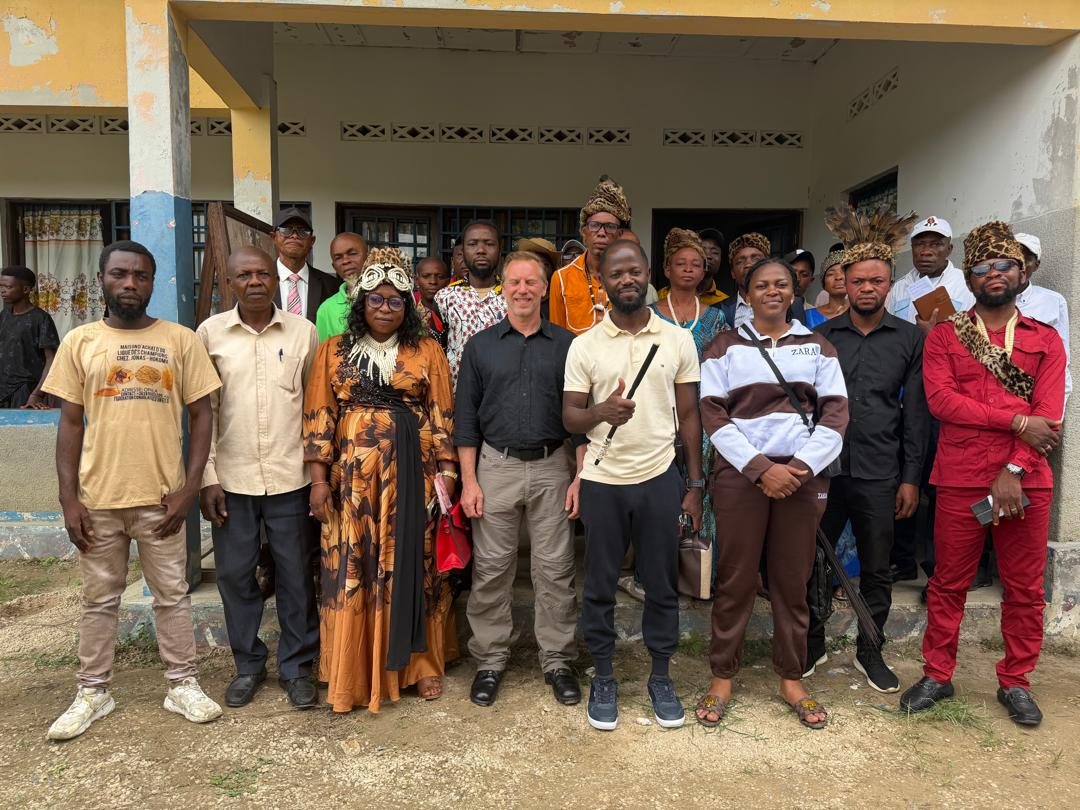
A Kimbole version of this Site is under preparation.
In keeping with the Fund's mandate to preserve and transmit the Mbole mother tongue, a full Kimbole-language version of fdm-mdf.org will be published in due course. Until then, the Site is available in English and French — our two documentary languages. Our gratitude for your patience.
A people, a language,
a meeting place.
The Mbole are the indigenous people of what is today Kisangani — the third city of the Democratic Republic of the Congo. The name Kisangani is not Swahili. It is Kimbole — our mother tongue — and it means the meeting place.
Long before the colonial surveys, long before the Congo River was given foreign titles, the Mbole were here. We cleared the forest, named the rivers, and received travellers under the arms of the same trees that still stand today in Opala Territory.
The Mbole people number more than one million — across Opala Territory, in Kisangani, and in the diaspora. The Fund's work begins with remembering our story accurately, and carrying it forward on our own terms.
Between 2023 and 2025,
a walk through fire.
The conflict was triggered by the illegal sale of Mbole ancestral land by local government officials. The Mbole defended their land. More than two thousand lost their lives. Over one hundred were arrested without reason — twenty-eight died in Kisangani's prisons; many remain detained without trial. The Fund was forged in that walk.
The Letter to the Presidency
LOMO ATIWANA, Supreme Leader of the Mbole, addresses a formal memorandum to President Félix Tshisekedi regarding the escalating Mbole–Lengola conflict in Tshopo Province.
Presidential Acknowledgement
The President addresses the matter publicly for the first time, recognising the gravity of the situation on the ground.
First Presidential Visit to Kisangani
The first of two presidential visits to the province. Dialogue opens between the communities, the military, and national authorities.
The Contract Annulled · Second Presidential Visit
The disputed land concession is annulled. The President makes his second and final visit — a pivotal turn toward lasting resolution.
The Peace Forum
Three days of structured dialogue between the Mbole, the Lengola, and provincial authorities — establishing the framework for reconciliation.
The Osio Ceremony
The traditional peace rite is performed. The two peoples exchange the ancestral oath; the conflict is ritually closed. The Fund begins its public work the day the elders give their blessing.
Launch of the Mbole Development Fund
The Fund is formally constituted as an ASBL-ONG under DRC law, with its seat at Opala Centre and its charter adopted by the eleven chiefdoms. Registration F.92/59.333.
A tongue, a tree,
a kinship.
The Kimbole language is a living archive — the vessel in which our cosmology, our proverbs, our laws, and our kinship structures travel across generations. Its preservation is not a sentimental project. It is a sovereign one.
Mbole social life is organised around the sector and chiefdom — eleven in Opala Territory — each with its own elder council, each sending a voice to the wider nation. Leadership is earned through usefulness, not inherited through silence.
The Fund exists to make these structures legible to the modern world without ever reducing them to it.
Called into being
by the moment.
MDF was not founded at a desk. It was founded in the hours after the Osio ceremony, when the elders asked a single question: "Now that we are whole again — what will we build?"
The Fonds de Développement Mbole is a non-profit community charity association (ASBL-ONG), legally registered under Democratic Republic of Congo statutes. Its charter is bilingual — French and English — and its mandate spans culture, development, language, conservation, and the economic emancipation of the Mbole territory.
The Fund is constitutionally independent of political office and commercial enterprise. Its sole accountability runs to the eleven Chiefdoms of Opala, whose chiefs compose its Board.
MDF is deliberately apolitical. It does not campaign for any party, any official, or any candidate. Its only cause is the dignity and prosperity of the Mbole people of Opala Territory.
Three words. Everything else follows.
Every program, every decision, every line item in every budget is tested against these three words. If it fails one, it does not pass.
Unity
Eleven chiefdoms, one voice where it matters. Unity is not uniformity — it is the discipline of listening before speaking and of settling internal disagreements before external ones.
Discipline
Discipline is what separates a movement from a complaint. Every commitment MDF makes — to a donor, to a villager, to a partner — is tracked, honored, and closed.
Organization
Organization is the multiplier. Without it, energy disperses; with it, the smallest effort can lift a territory. Our charter, our tiered governance, our annual assemblies — each exists to convert will into outcome.

"I did not found MDF to be its centre. I founded it to be its quiet gear."
The work in front of us is larger than any one name. If I can be useful as a convenor, as a scribe, as a man who keeps the doors unlocked for the elders and for the generation after them — I will count that enough.
We thank, in advance, every hand that joins. We will honor each contribution by remaining exactly what we are: a Fund of our people, for our people, answerable first to them.
Eleven chiefdoms,
one homeland.
Opala Territory stretches across the interior of Tshopo Province — rainforest, rivers, and a mosaic of sectors and chiefdoms that together compose the Mbole nation.
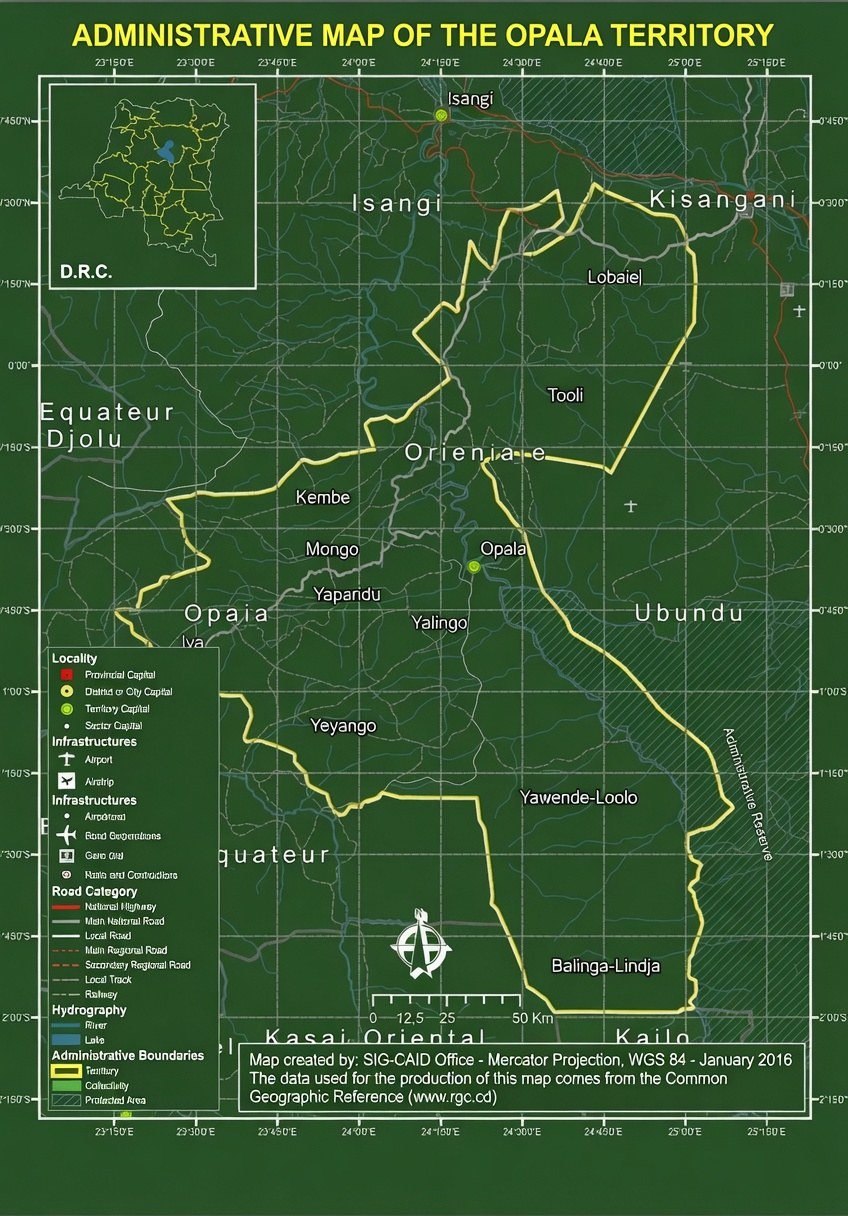
Our homeland encompasses eleven recognised sectors and chiefdoms, each with its own customary council. The territory borders Isangi Territory to the north, Ubundu Territory to the east, and Maniema Province to the south.
It is traversed by the Lomami River and its tributaries, and includes the Mbole portions of Lomami National Park. Opala Centre is the administrative heart of the territory and the seat of the Fund.
More than 70% of the Lomami National Park — one of Central Africa's most important biodiversity reserves — lies within Opala Territory, on Mbole customary land. Its stewardship is inseparable from the future of the Mbole people.
Sectors and chiefdoms
of Opala.
Secteur Lobaie
Secteur de Tooli
Secteur Balingalindja
Secteur des Iyé
Secteur Yawende Loolo
Chefferie Mongo
Chefferie Kembe
Chefferie Yapandu
Chefferie Yomaie
Chefferie Yeyango
Chefferie Yalingo
At the heart of the
Congo Basin.
The land of the Mbole sits inside the second-largest tropical rainforest on Earth — a forest the world has come to call the planet's last lungs. To stand in Opala is to stand at the centre of that breath.
The Congo Basin holds nearly a quarter of the world's remaining tropical rainforest. After the long, slow harm done to the Amazon and to the forests of Southeast Asia, what remains here in Central Africa carries a weight that is no longer only ours. It belongs, in a sense the elders have always understood, to the breathing of every continent.
The Mbole homeland — Opala Territory and the broader Mbole zone — lies in the inner heart of this basin. The Lomami River runs through it. The Lomami National Park, one of the most biologically important reserves in Central Africa, includes Mbole portions. The wildlife corridors, the carbon sinks, the headwater streams that feed the Congo River — they pass through ground that has been Mbole ground for as long as memory reaches.
For the Mbole, this is not an abstract inheritance. It is a daily relationship. Forest gives food, medicine, building material, ceremonial space, the names of children. The river gives passage and protein. The soil gives cassava, rice, palm. A people who live this closely with a forest do not need to be persuaded to defend it. They have always defended it.
What the Mbole ask of the world is not pity. It is recognition: that the protection of this land is, increasingly, the protection of something the world cannot replace.
The land may be
built upon.
It may not be sold.
Mbole law on land is older than Mbole writing. Land is held in trust between the living, the ancestors, and those not yet born. To sell it is to remove it from that trust — and that, in our tradition, is forbidden.
This is not a refusal of development. The Mbole are open to roads, schools, clinics, mining cooperatives, agricultural ventures, conservation partnerships, and ecotourism — to anything that uses the land in ways that strengthen the people who live on it. We are not opposed to investment. We are not opposed to industry that respects communities and ecosystems. The Fund itself was built to make development of this kind easier, faster, and fairer.
But selling the land — transferring its title away from the Mbole — is a different act, and one our culture does not allow. The land is not the chief's to sell. It is not the family's to sell. It is not the state's to sell on behalf of a people who were never consulted. It is held; it is used; it is passed on. It is not converted into someone else's deed.
This is the principle that was bypassed when a portion of Mbole ancestral land — more than four thousand hectares — was contracted out to a private company without the knowledge or consent of the Mbole people. The contract has since been annulled, and the land returned to its proper status. But the lesson holds: where Mbole are not at the table, decisions about Mbole land cannot be allowed to stand.
This rule is not a barrier to partnership. It is the foundation of any partnership worth having. Investors, conservationists, governments, and neighbouring communities are welcome to work with the Mbole — on terms that honour the people whose home this is.
We have stood between
the forest and
those who would take it.
Every threat that has come for this part of the basin — whether from logging concessions, opaque concessions to outsiders, or extractive ventures unwilling to consult — has met the resistance of the Mbole. Quietly, and where necessary, publicly. To this day, the record is unbroken.
We are not against development. We are against the pattern, repeated on continent after continent, in which corporations arrive, extract, and leave a forest that no longer breathes. That pattern will not be repeated here. Not on Mbole land.
There is a simple test that the Mbole apply to any project proposed for our territory. Does it leave the forest healthier than it found it? Does it leave the people stronger than it found them? Does it respect the rule that the land is not for sale? If a project answers yes to all three, it has a partner in the Mbole. If it cannot, it has nothing here.
This is the position the Fund carries forward — into ministries, into investor rooms, into multilateral conservation forums. It is also the position we ask our partners and supporters to understand.
Supporting the Mbole is not philanthropy in the abstract. It is supporting one of the few peoples in the world still living, governing, and defending the inner heart of a forest the planet cannot afford to lose. Every school we keep open, every cooperative we register, every chief we equip to negotiate, every young Mbole we send to a university and bring home — strengthens the human shield that this forest has always quietly relied on.
If you are reading this and looking for a place where your support travels further than its weight — where the people you help, in turn, help a forest the world depends on — you are looking, we believe, at the right place. We will be glad to walk with you.
Six bodies of work,
one territory.
Each initiative is led by a dedicated team and tracked against measurable milestones. They are not a list of ambitions. They are a schedule of deliveries.
PCDÉMMbole Community Economic Development Plan
A multi-year, sector-by-sector roadmap anchoring roads, water, electricity, schools, clinics, agriculture and livelihoods. Launched in Opala Centre during the Founder's territorial visit of 22–27 March 2026.
Volume IThe Mbole Encyclopedia
A canonical archive of Mbole knowledge: oral histories, customary law, botanical medicine, genealogies of the chiefdoms, and accounts of the great migrations. Edited under a standing committee of elders and scholars, published in Kimbole and French.
LexiconKimbole Dictionary Project
The first formal dictionary of the Kimbole language, documenting vocabulary, orthography, idioms, and etymologies — including the recovery of terms under threat of loss. Designed as the basis for future pedagogy, legal translation, and cultural transmission.
REDD+ FrameworkConservation & Biodiversity
Still in development. A long-term conservation framework for the Opala ecosystem — the revenue it generates will be reinvested to develop the community and to fund MDF development projects across the participating chiefdoms.
Territorial MovementThe Awareness Tour
An ongoing programme to keep watch over what is happening across the land and to keep the people mobilised and regularly informed — a continuous presence maintained throughout the eleven chiefdoms.
Opala MediaIndependent Regional Platform
An independent bilingual media outlet covering the Opala region — written and produced by young Mbole journalists — with editorial safeguards, a public charter, and AI-assisted translation to reach audiences in French, English, and Kimbole.
From promise
to build.
The Initiatives set the direction. The Projects are what is actually being built, funded, and delivered on the ground — each governed by MDF's approval, execution, and reporting framework.
Bokuma–Kisangani Volunteer Road
MDF financed and equipped a group of young Mbole volunteers from the Bokuma Village grouping who took the courageous initiative of beginning, with their own hands, the construction and rehabilitation of the road connecting Bokuma to Kisangani. The Fund provided tools, personal protective equipment (PPE), and food rations to improve their working conditions. These young builders are still at work today — the first visible proof that the PCDÉM is not a promise, but a build already underway.
Opala Asphalt Roads Programme
Opala Territory has never had a single asphalt road in its history. MDF intends to finance and activate multiple road construction and modernisation initiatives across the territory — connecting all eleven sectors and chiefdoms to each other and to the provincial network. These roads will transform access to markets, healthcare, and education for thousands of Mbole families.
Bridge Construction & Rehabilitation
Multiple small and medium bridges must be built across Opala Territory to facilitate the free movement of people and goods. Many existing bridges have been swept away or are failing. A number of structures — originally built through the solidarity of local communities — require urgent rehabilitation. Other stretches demand entirely new construction.
Opala Carbon Project
A REDD+ carbon credit project covering the entire Opala Territory. In partnership with Royal Heritage Group (United States) and Castle Rock (United Kingdom), this project will certify Mbole forest capital under the Verra or Gold Standard. All proceeds are managed by MDF for the exclusive benefit of Mbole communities, creating sustainable passive income over 40+ years.
Mbole Agricultural Programme · Opala Perfumed Rice
Development of Opala's perfumed rice — the DRC's leading producer — through improved farming techniques, storage facilities, crop diversification, livestock integration, aquaculture, and direct access to regional markets. Designed in coordination with the Mbole Agricultural Cooperative.
Mbole School Network · Nursery to University
Construction of a community school network — nurseries, primaries, secondaries, and ultimately a university. Priority to remote areas of Opala, with adapted school fees and community scholarships. Kimbole language teaching is mandatory across the curriculum.
Community Health Centres · 11 Sectors
Construction of health centres and clinics across all eleven sectors of Opala, staffed with qualified medical personnel and essential medicines. Includes a maternal and child health programme and community health insurance scheme.
Solar & Micro-Hydro Electrification
A phased electrification plan combining solar micro-grids in dispersed villages with river-fed micro-hydroelectric installations at suitable sites. The objective is universal electrification across the eleven chiefdoms within the PCDÉM horizon.
Universal Drinking Water Access
Boreholes, community wells, and a rolling programme of water point construction across the eleven sectors — designed to guarantee each Mbole household safe drinking water within walking distance, and to serve the schools and clinics built under the network.
Opala Economic Zone
A dedicated economic zone at Opala Centre to host MDF operations, the Mbole Agricultural Cooperative, Opala Media, and allied community enterprises. Site clearing has already commenced through volunteer mobilisation; infrastructure build-out will follow the securing of funding partners.
Detainee Advocacy Dossier
A legal-advocacy file maintained for the Mbole citizens arrested without charge during the 2023 conflict. Of more than one hundred detained, twenty-eight have died in Kisangani's prisons and many remain without trial. MDF's Legal Counsel compiles the case, liaises with counsel of record, and advocates for due process and release.
Mbole Encyclopedia & Dictionary Programme
The operational project supporting Initiatives II and III. Field recording equipment, editorial teams, and publication logistics for the first full compilation of Mbole oral history, customary law, and language — to be distributed in print and open-access digital formats.
Lomami National Park · ICCN Partnership
A framework of cooperation with the Institut Congolais pour la Conservation de la Nature (ICCN) governing the portions of Lomami National Park that sit within Mbole customary territory — reconciling conservation obligations with the community's historic rights of access and stewardship.
Our work,
in pictures.
Photographs and video documenting the initiatives and projects in progress — from the Osio ceremony to the volunteer road, from the awareness tour to the conservation compact.
Every decision
carries a name.
The Fund is structured in six concentric tiers — from the Founder and Chairman outward through the Board, Advisors, and Management. Each tier holds distinct powers. None may act alone.
Founder & Chairman
Carrier of the traditional Mbole title LOMO ATIWANA, and the international spokesperson for the Mbole people of Opala Territory. Founding Chairman of the Mbole Development Fund with an open, unindexed mandate affirmed by the Council of Chiefs.
His work spans the civic, the cultural, and the economic — bridging the councils of Opala with partners in Kinshasa, Kampala, Nairobi, Sydney, and Dubai.
Senior Advisors · Opala Advisory Council
Five senior counselors whose brief is to advise the Founder and the Board on matters of tradition, strategy, and continuity. They lead the territorial Awareness Tour.

Chef Osumaka-Okenga-Sango Jeannot
Chairs the Advisory Council. Leads the territorial awareness tour and the formalization of tribal structure across the eleven chiefdoms.
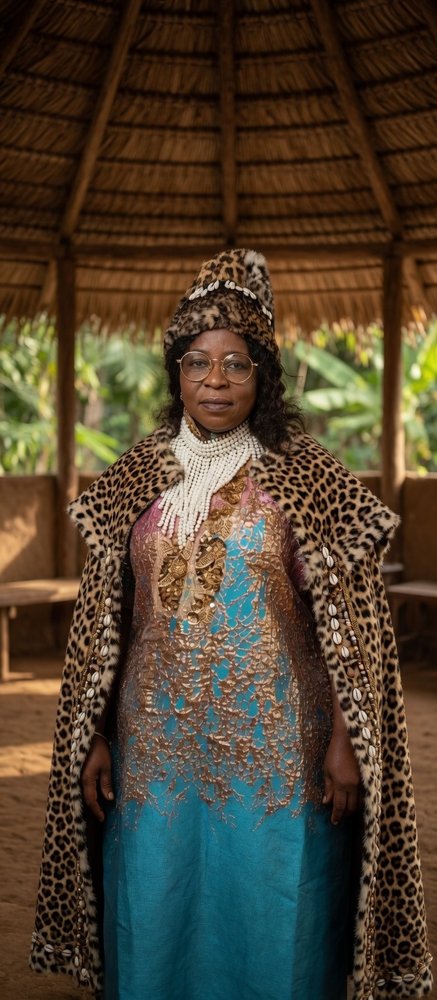
Chef Ossi-Honoko Lylie
Deputy to the Council President. Portfolio: cultural preservation and editorial standards of the Mbole Encyclopedia.
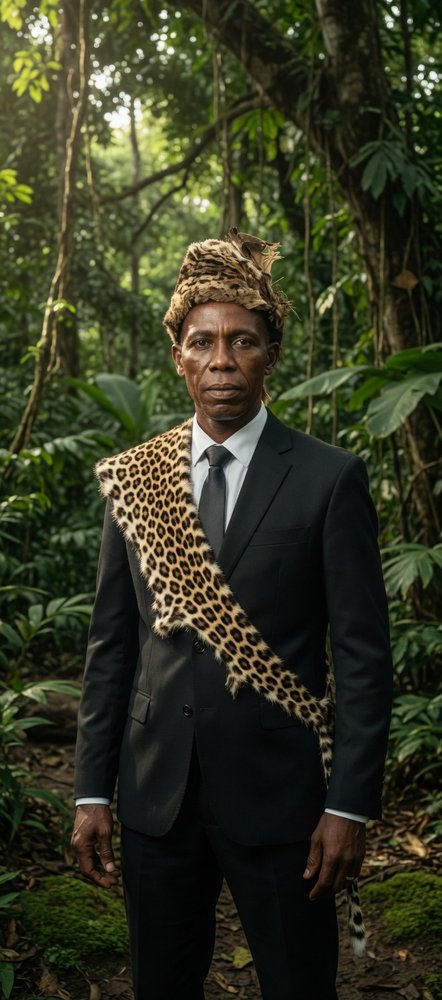
Chef Atayaka-Ameneseni Felly
Custodian of Council records and minutes. Coordinates the Kimbole dictionary initiative and documentation of elder testimonies.
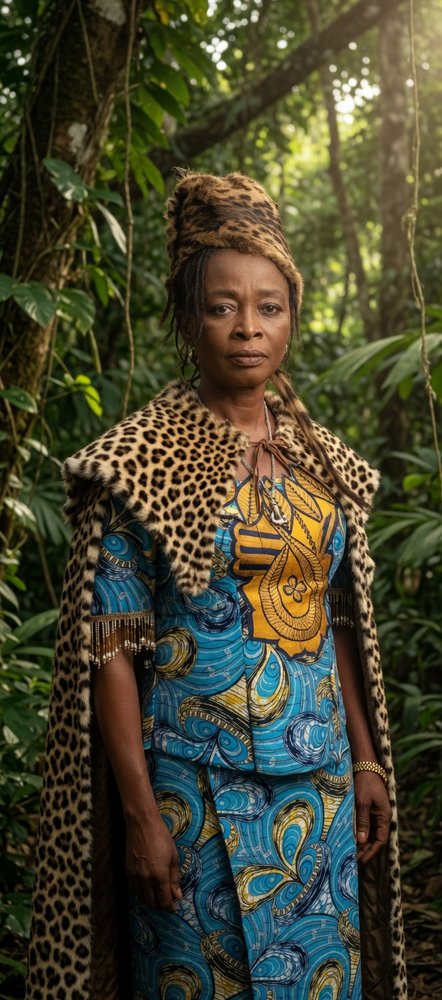
Chef Konga-Lokolo Marie
Senior counselor with portfolio in intergenerational transmission, women's councils across the chiefdoms, and youth leadership development.
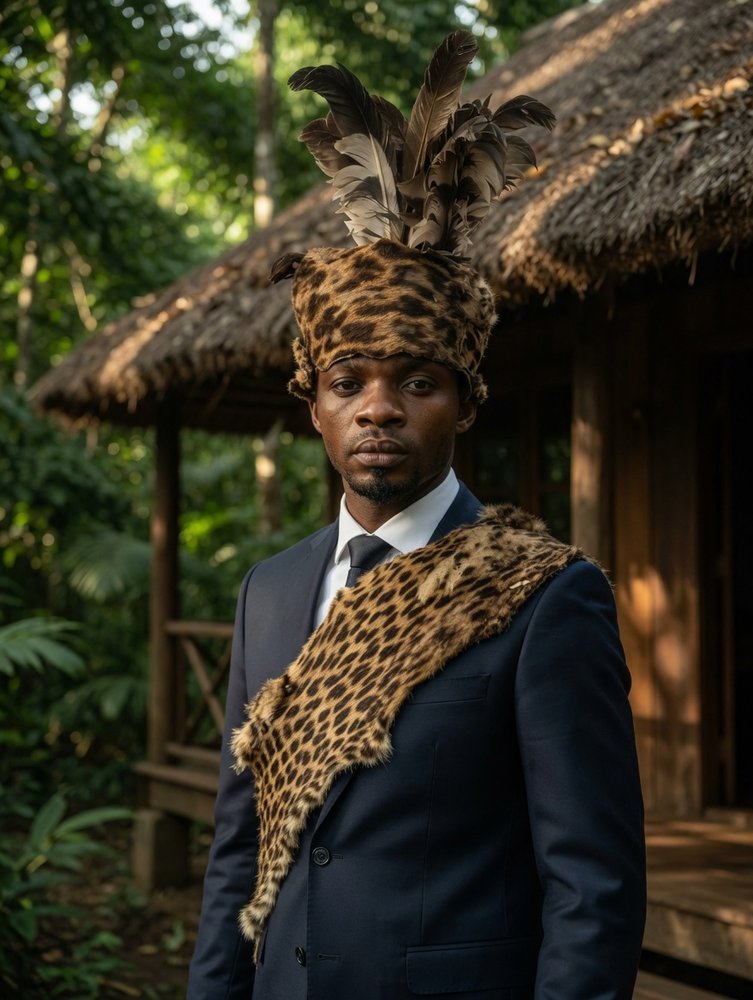
Chef Kanga-Losili Carlos
Senior counselor with portfolio in community governance, regional liaison with Kisangani, and protocol across the provincial authorities.
Coordination Team
The operational core of the Fund — appointed to translate decisions from the Board into daily execution across the territory and abroad.
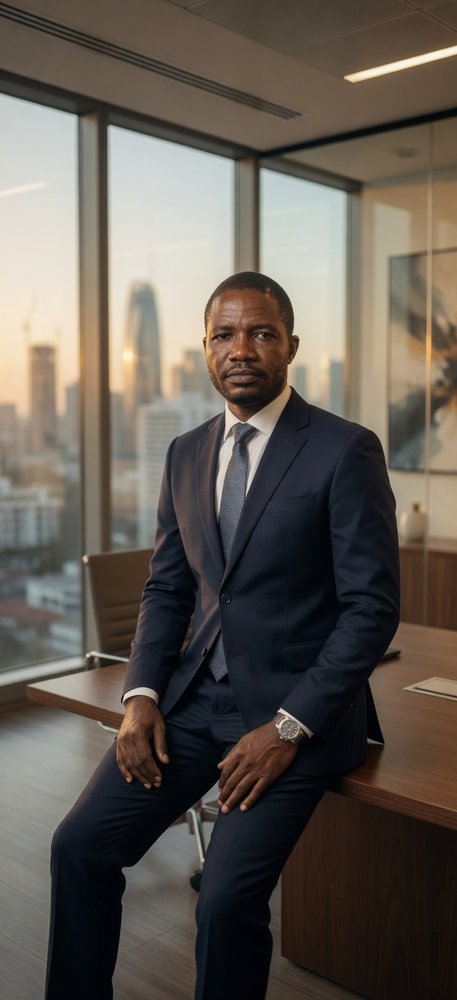
IMOKO LOKOMBA César
Leads community training programmes across the territory and monitors regulatory compliance. Field lead for the awareness tour and sectoral assemblies.
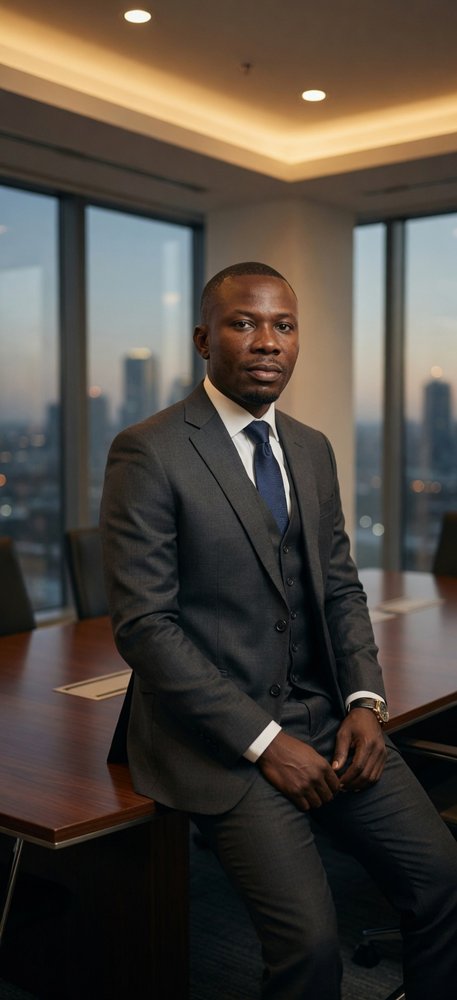
OSUMAKA MENDE Léon
Supervises active sites, coordinates field supervisors across all eleven sectors, and reports to the Board on execution status. Signs operational authorizations up to the Board-delegated ceiling.

ITOMA ECHUMO Alain
Manages the community–foundation interface, handles operational security coordination, and maintains communications with partners and impact reporting.
Board of Directors · Council of the Eleven
The constitutional heart of the Fund. One member per chiefdom. Full executive authority: approval of the annual budget, ratification of strategic initiatives, appointment of the Management Team, and issuance of Fund-wide directives. No action of the Fund proceeds without the Council's assent.
Secteur Lobaie
Voting seat on all Board resolutions. Champions the sector's budget allocation and initiative priorities.
Secteur de Tooli
Voting seat on all Board resolutions. Authority to convene sectoral assemblies and bring community matters to the full Board.
Secteur Balingalindja
Voting seat on all Board resolutions. Oversees sectoral implementation of Board-approved initiatives.
Secteur des Iyé
Voting seat on all Board resolutions. Co-signs official correspondence to provincial and national authorities concerning the sector.
Secteur Yawende Loolo
Voting seat on all Board resolutions. Custodian of sectoral customary records submitted to the Encyclopedia committee.
Chefferie Mongo
Voting seat on all Board resolutions. Liaison on conservation and REDD+ compliance for the chiefdom's protected forest zones.
Chefferie Kembe
Voting seat on all Board resolutions. Approves sectoral adoption of PCDÉM economic plans and reports milestones to the full Board.
Chefferie Yapandu
Voting seat on all Board resolutions. Custodian of Kimbole linguistic heritage specific to the chiefdom's dialectal variants.
Chefferie Yomaie
Voting seat on all Board resolutions. Convenes youth councils within the chiefdom and reports their formal positions to the Board.
Chefferie Yeyango
Voting seat on all Board resolutions. Liaison on conflict prevention and mediation matters within the chiefdom's boundaries.
Chefferie Yalingo
Voting seat on all Board resolutions. Oversees the annual sectoral audit submission to the Fund's transparency registry.
Management Team
The professional staff that runs the Fund day to day. Appointed by the Board and accountable to the Chief Coordinator. The team works on a contract and mandate basis, with each appointment renewed on the basis of performance and measured KPIs.
Executive Director
Operational head of the Fund. Implements Board resolutions, supervises program managers, signs contracts within delegated thresholds.
Director of Programs
Oversees the six initiatives and the full project register. Delivery owner against quarterly milestones.
Finance & Treasury Director
Custodian of accounts, budgeting officer, liaison with independent auditors. Publishes the Fund's annual transparency statement.
Legal & Governance Counsel
Maintains the Fund's legal registrations, statutes, and regulatory compliance in DRC and in partner jurisdictions. Secretary to the Board.
Communications & Media Director
Stewardship of the Fund's voice across French, English, and Kimbole. Editorial oversight of Opala Media and official publications.
Director of Conservation & Land
Leads the REDD+ conservation compact, manages the Fund's environmental mandate, and liaises with ICCN and international conservation partners.
Director of Community & Territory
Field office across Opala. Organises the awareness tour logistics, sectoral councils, and the engagement of youth and women's assemblies.
Director of Partnerships & Diaspora
Cultivates international partnerships, diaspora giving, and the Fund's representation at international cultural and development fora.
Walk beside us.
Every step counts.
The Fund is still early in its public work. Global giving infrastructure is under construction. Donors, cultural partners, and diaspora members wishing to engage should write directly — and the Fund will respond in person.
Direct giving to the Fund
All donations are received and administered at the Fund's Opala Centre office. Each gift is acknowledged in person by the Finance & Treasury function and accounted for in the annual transparency report.
Partnership is conversation.
We welcome correspondence from governments, international foundations, cultural institutions, academic partners, and individual patrons. The Fund takes each enquiry as the beginning of a long relationship, not a transaction.
We respond to every serious approach within five working days. We ask, in return, patience with our pace — the Fund moves in step with the Council of the Eleven, and important decisions are ratified in their own time.
Those wishing to contribute time, expertise, or introductions will find a particularly warm welcome. Our Kimbole Dictionary, Encyclopedia, and Awareness Tour teams actively seek volunteer contributors.
Beyond giving, beyond partnership.
Direct gifts and institutional partnerships are not the only doors into MDF's work. The Fund welcomes a wider circle of involvement — wherever your skills, time, or position can serve the Mbole nation, we will find a place for you.
Volunteer your time
Field volunteers for the Awareness Tour, Encyclopedia intake teams, and Kimbole Dictionary contributors. Both diaspora-based remote work and on-the-ground presence in the eleven chiefdoms are welcomed.
Donate skills & expertise
Lawyers, accountants, translators, archivists, conservation scientists, journalists, designers, and technologists are invited to contribute pro bono work to specific Fund initiatives.
Advisory & ambassador roles
Senior figures in diplomacy, philanthropy, conservation, or business may be invited to join the International Advisory Board or serve as named ambassadors of the Fund's work.
Academic collaboration
Universities, research institutes, and individual scholars working on Congo Basin anthropology, ethnography, ecology, linguistics, or post-conflict studies are invited to propose joint projects.
Diaspora chapters
Mbole and Congolese diaspora communities are invited to form local chapters that fundraise, host cultural events, and represent the Fund in their cities of residence around the world.
In-kind contributions
Equipment, transport, lodging during field missions, professional services, books, and archival materials are gratefully received and individually acknowledged in the Fund's annual report.
For any of the above, please write to contact@fdm-mdf.org with a brief introduction and the form your involvement might take. The Fund's Director of Partnerships & Diaspora will respond personally.
Democratic Republic of the Congo
The rules
of engagement.
This website (fdm-mdf.org) is operated by the Fonds de Développement Mbole — Mbole Development Fund (hereafter "MDF" or "the Fund"), a non-profit community charity association (ASBL-ONG) registered with the Ministry of Justice of the Democratic Republic of the Congo under reference F.92/59.333. By accessing or using the Site, you agree to the following Terms of Use. If you do not agree, please do not use the Site.
1 · Purpose of the Site
The Site exists to inform the public, donors, partners, and members of the Mbole community about the Fund's mission, governance, initiatives, projects, and engagement channels. The Site does not offer commercial goods or services. Any financial contribution made to the Fund through contact channels listed on the Site is received and administered under the Fund's non-profit statutes.
2 · Accuracy of Information
The Fund makes every reasonable effort to publish accurate and current information. However, content on the Site — including financial figures, project status, leadership composition, and partner listings — may be updated without prior notice. The Fund does not warrant that the Site is free from error, interruption, or technical defect.
3 · Intellectual Property
All content appearing on the Site — text, graphics, logos, photographs (whether active or placeholder), video embeds, design, software, and the compilation thereof — is the exclusive property of the Fund or its licensors and is protected under Congolese and international copyright law. In particular:
- The MDF emblem and the name "Fonds de Développement Mbole" / "Mbole Development Fund" are protected identifiers of the Fund.
- The word "Kimbole", its lexicon, and any Kimbole-language content on the Site form part of the cultural heritage of the Mbole people, and are published here under the Fund's stewardship.
- No element of the Site may be reproduced, redistributed, or used for commercial purposes without the Fund's prior written consent.
- Non-commercial citation with clear attribution to the Fund is permitted for scholarly, journalistic, and cultural purposes.
4 · Acceptable Use
Users agree not to use the Site in any manner that could:
- Violate applicable Congolese or international law.
- Impersonate the Fund, its officers, advisors, board members, or management staff.
- Attempt to gain unauthorised access to any Site infrastructure, databases, or administrative tools.
- Introduce malicious code, disrupt Site operation, or interfere with other users' access.
- Collect personal data of other users or of the Fund's staff through automated means.
- Use the Site to defame, harass, or threaten the Fund, the Mbole community, or any other party.
5 · Donations and Contributions
Where the Site invites direct donation correspondence to donate@fdm-mdf.org or by telephone to +243 999 633 101, donors acknowledge that: the Fund receives each contribution in its capacity as a registered non-profit ASBL-ONG; all contributions are recorded and acknowledged individually; the Fund reserves the right to decline any contribution that would compromise its political neutrality, ethical standards, or Congolese law; and global online giving infrastructure is currently under development — until such time, donors should correspond directly with the Fund.
6 · Third-Party Links and Services
The Site may contain links to or embed content from third-party services — including, for example, embedded YouTube video players in the Territory / Gallery section. The Fund does not control the content or practices of third-party platforms and is not responsible for their privacy or operational policies. By interacting with embedded third-party content, you may be subject to the terms and policies of those third parties.
7 · Political Neutrality
MDF is constitutionally and operationally apolitical. The Site is never used to endorse any political party, candidate, public official, or partisan position. Content concerning the Mbole–Lengola conflict, the resolution framework, and related civic matters is published in a historical and factual capacity only.
8 · Limitation of Liability
The Site is provided "as is". The Fund does not warrant uninterrupted availability, freedom from error, or compatibility with every user environment. To the maximum extent permitted by applicable law, the Fund disclaims liability for any indirect, incidental, or consequential losses arising from the use of the Site. Nothing in these Terms limits liability for matters that cannot be limited by law.
9 · Modifications
The Fund may revise these Terms of Use from time to time. Material changes will be signalled by an update to the "Effective" date above. Continued use of the Site after any such change constitutes acceptance of the revised Terms.
10 · Governing Law and Disputes
These Terms are governed by the law of the Democratic Republic of the Congo. Any dispute arising from use of the Site will be resolved first through good-faith direct dialogue with the Fund's Legal & Governance Counsel. Failing settlement, the competent courts of Kisangani, Tshopo Province, shall have jurisdiction, without prejudice to any peremptory rules of law that apply in the user's country of habitual residence.
11 · Contact
Questions concerning these Terms should be directed to:
- Email: contact@fdm-mdf.org
- Telephone: +243 999 633 101
- Address: MDF / FDM ASBL-ONG · Opala Centre · Tshopo Province · Democratic Republic of the Congo
Your data.
Our duty.
This Privacy Policy describes how the Mbole Development Fund ("MDF") collects, uses, and protects personal data in connection with its website (fdm-mdf.org), its correspondence with donors and partners, and its programmatic activity. We treat the protection of personal data as an extension of the discipline and trust that our mission requires.
1 · Data Controller
The data controller for all processing described in this Policy is the Fonds de Développement Mbole (MDF), a DRC-registered ASBL-ONG (F.92/59.333), with its seat at Opala Centre, Tshopo Province. Correspondence regarding this Policy should be sent to contact@fdm-mdf.org.
2 · Data We Collect
The Fund collects personal data only to the extent necessary for its charitable mission. Depending on your interaction with us, this may include:
- Correspondence data — name, email address, and message content when you write to any of our institutional mailboxes (contact@, donate@, media@).
- Donation records — donor name, contact details, contribution amount, date, and any allocation instruction, recorded for internal acknowledgement and the annual transparency statement.
- Partner records — institutional name, representative contacts, and nature of engagement for partner entities.
- Volunteer and member data — name, contact, area of expertise, and availability for those who volunteer to support our work (e.g., Kimbole Dictionary contributors).
- Technical data — limited technical information automatically provided by your browser (anonymised IP, browser type, pages visited) for security and Site-improvement purposes.
3 · Lawful Basis for Processing
Where applicable data-protection law requires a lawful basis, the Fund processes personal data on the following grounds:
- Consent — for newsletter subscription (where available) and cookie categories you explicitly accept.
- Contract / pre-contract — for donor acknowledgements, partner agreements, and volunteer intake.
- Legal obligation — to meet our accounting, reporting, and registration obligations as a DRC ASBL-ONG.
- Legitimate interest — to operate, secure, and improve the Site, to protect the Fund against fraud, and to fulfil our charitable mission.
4 · How We Use Your Data
We use your personal data strictly for the purposes disclosed to you, including: to respond to your enquiry; to record and acknowledge your donation; to manage partnership or volunteer engagement; to produce the Fund's annual transparency report; to meet our statutory obligations; to operate, secure, and improve the Site; and for no commercial, marketing-resale, or profiling purpose.
5 · Cookies
The Site uses a minimal set of cookies and similar storage. We distinguish:
- Strictly necessary — required for core Site operation. Examples: your language preference (EN / FR), your cookie-consent decision itself. These are not subject to consent.
- Performance & improvement — used to understand anonymised Site usage. Set only if you accept.
- Third-party embeds — when you interact with embedded video (YouTube) in the Gallery, the third-party platform may set its own cookies under its own policy.
Your cookie consent is recorded in local storage. You may withdraw or adjust consent at any time by clearing your browser's local storage for this Site.
6 · Data Sharing
We do not sell, rent, or trade personal data. We share personal data only with: the Fund's officers, advisors, and staff, strictly on a need-to-know basis; our auditors and the Fund's legal counsel, under professional confidentiality; authorised service providers (e.g., email infrastructure) under written data-processing commitments; and competent authorities where disclosure is legally required.
7 · International Transfers
The Fund is DRC-domiciled. Certain processors (email, hosting, embedded video) may operate outside the DRC. Where such transfers occur, the Fund requires processors to apply safeguards at least equivalent to those of the DRC data-protection regime, and, where applicable to data subjects in other jurisdictions, to meet the standards of that jurisdiction (including, where relevant, the EU General Data Protection Regulation).
8 · Data Retention
We retain personal data only as long as needed for the purposes set out above and to meet our statutory obligations. Indicative retention periods: correspondence — 3 years from last contact; donor and partner records — 10 years, in line with DRC accounting obligations; volunteer records — the duration of engagement plus 2 years; technical logs — 12 months.
9 · Your Rights
Subject to applicable law, you may: request access to the personal data we hold about you; request correction of inaccurate data; request erasure of data no longer needed for our mission; object to certain processing or withdraw consent; request restriction of processing in certain cases; and request portability of data you have provided to us. To exercise any right, write to contact@fdm-mdf.org. We will respond within a reasonable period and in any event within one month for requests that fall under the EU GDPR.
10 · Security
We implement administrative, technical, and physical safeguards appropriate to the sensitivity of the data we hold, including access controls, encrypted transmission for the Site, and professional-grade email infrastructure. No system is perfectly secure; we ask donors and partners not to transmit sensitive financial details (bank account numbers, card credentials) via unsolicited email, and to use Fund-confirmed channels instead.
11 · Children
The Site is not directed at children under the age of 15. We do not knowingly collect personal data from minors without parental or guardian consent. If you believe we hold data of a minor submitted without appropriate consent, please contact us so we can delete it.
12 · Changes to this Policy
We may update this Policy to reflect changes to our practice or to applicable law. Material changes will be signalled by an update to the "Effective" date above and, where appropriate, by a notice on the Site. Continued use of the Site after such an update constitutes acceptance of the revised Policy.
13 · Contact & Complaints
Questions, requests, or complaints relating to this Policy should be sent to:
- Email: contact@fdm-mdf.org
- Telephone: +243 999 633 101
- Address: MDF / FDM ASBL-ONG · Opala Centre · Tshopo Province · Democratic Republic of the Congo
Data subjects resident in the European Union or other jurisdictions with a supervisory authority retain the right to lodge a complaint with their local supervisory authority.